.jpg)
Learning to Be Autistic: When a diagnosis becomes an identity
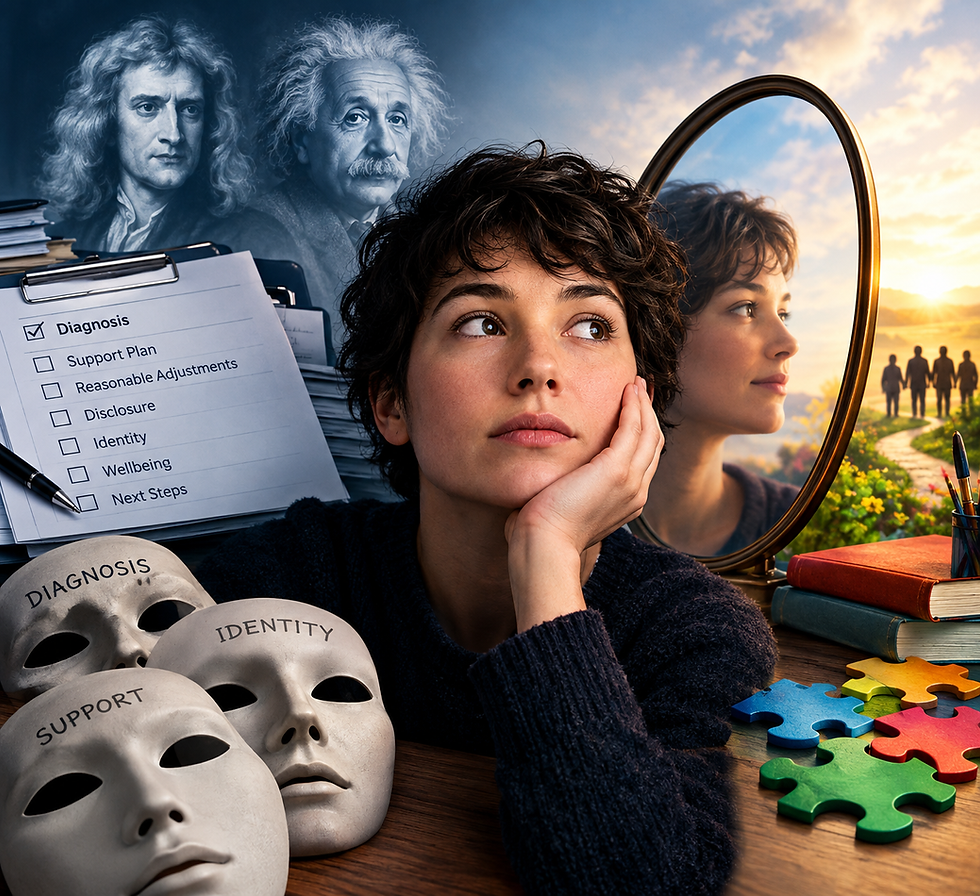
Autism is real. Disability is real. Support can be essential, sometimes life-changing, and sometimes the difference between exclusion and participation. But it does not follow that a diagnosis should become the organising principle of a person’s entire identity, or that every difficulty, preference, gift, habit, wound, achievement and failure should be interpreted through one label.
In some ways, the past may have been easier – not because society was kinder or more enlightened, but because employers cared less about labels and more about whether someone could do the work. A brilliant, eccentric, socially awkward specialist might simply be tolerated because the organisation needed his mind. Today, by contrast, the same person may enter the workplace already framed through a diagnosis, a disclosure dilemma, a support plan, and a set of expectations about identity, vulnerability and institutional responsibility.
Figures such as Einstein, Newton, Mozart and others are often retrospectively described as possibly autistic. The point here is not to diagnose the dead, nor to claim them for one camp or another. They are useful for a different reason. They allow us to ask a deliberately uncomfortable question: What happens when a person is understood first as a diagnosis, rather than first as a person who happens to have one?
Thought experiment 1: Newton Without the Support Plan
How did Newton become the Newton we know without special treatment, accommodations, services, or even the faintest idea that autism existed? He did not know he was autistic. His family did not know. His friends did not know. His rivals certainly did not know, though they might have produced several unkind pamphlets if they had.
There was no form asking whether he required reasonable adjustments to gravity. No committee invited him to explore his “lived experience of apples.” No college officer asked whether his preference for solitude represented a barrier to collaborative excellence. Nobody suggested that, before attempting to describe the laws of motion, he should attend a workshop on interpersonal flexibility.
Newton’s world was not gentle. It was often brutal, competitive, socially unforgiving and emotionally cold. But it also sometimes allowed a peculiar bargain: if a person could produce something extraordinary, his peculiarities might be endured. Newton was not asked to explain himself before he was allowed to think. He was not required to translate his mind into the language of institutional care before being left alone with mathematics, optics, theology, alchemy and his own difficult obsessions.
The irony is that what might now be interpreted as symptoms, needs, barriers or identity markers were then simply part of the strange package called Newton. His solitude was not interpreted as a support need; it was the condition in which he worked. His intensity was not moderated into balance; it became the engine of discovery. His lack of ordinary sociability was not necessarily admired, but neither was it automatically treated as a professional development target.
This does not mean the past was better. It means the past sometimes failed in a different direction. It neglected people, but it also occasionally neglected to interfere. Newton may have suffered from that neglect, but he also benefited from the absence of a system determined to define, support, monitor and narrate him. Perhaps the uncomfortable question is this: would Newton have become Newton if he had spent less time calculating motion and more time demonstrating that his relationship with motion was being appropriately supported?
We cannot know. And that is precisely why it is a thought experiment. This is not nostalgia for the seventeenth century. Newton’s world was harsh, unequal and often unforgiving. The point is narrower and more provocative: he became Newton without an autism diagnosis, without diagnostic self-consciousness, without accommodations, without services, and without his “autistic identity”. His environment did not ask him first to become a case, a client, a disclosure decision or a supported employee. It asked, in effect, whether he could do the work.
The thought experiment, then, is deliberately unsettling. If Newton had been born into the present, would his attention have gone into mathematics, optics and gravitation – or would some of it have been diverted into forms, assessments, support meetings, identity language, participation in autism advocacy and explaining why he worked best alone while acknowledging the help from autistic communities and allies who provided regular supply of apples?
Perhaps the question is not how Newton managed without special treatment. Perhaps the question is whether, in some circumstances, too much attention to the management of the person can itself become an obstacle to the work the person is capable of doing.
Thought experiment 2: Einstein Without the Job Application and Accommodation Files
Albert Einstein’s early career also suits this argument because it began not with academic security but with failure to obtain a university assistantship after completing his studies. He was not immediately accepted by an enlightened institution eager to recognise unconventional brilliance. He tutored, waited, relied on personal recommendation, and eventually entered the Swiss Patent Office in Bern as a technical expert, third class. The important point here is not that Einstein “needed no support”. We can’t make such a claim. It is that the institution did not have to understand him as a diagnostic subject. It had to decide whether he could examine technical inventions.
And this is where the thought experiment becomes interesting in a modern context. Before anyone reached the question of technical ability, Einstein might have been invited to disclose, explain and manage his difference. Did he require adjustments? Could he demonstrate emotional flexibility? Was he able to work in a team? Would he be comfortable sharing his neurodivergent journey during inclusion week? Could he reassure the panel that his intense private thinking would not interfere with stakeholder engagement? The risk is not merely that he would be rejected. The risk is that the centre of gravity would shift from the work to the management of the worker.
The patent office was, in Einstein’s own joking phrase, a kind of “worldly cloister”: paid, regular, intellectually manageable work that left room for thought. It was not an autism service. It was not a personalised support package. It did not exist to (neuro-)affirm his “autistic identity” or process his needs. It simply gave him employment, routine, technical material and enough mental energy to continue thinking.
In 1905, while still outside the ordinary academic career track, he produced the papers that made his name. During that extraordinary year, Einstein published work on light quanta, Brownian motion, special relativity and mass-energy equivalence – achievements that transformed modern physics.
None of this depended on a formal vocabulary of autism, a reasonable-adjustments policy, a support coordinator or a requirement that he first become publicly fluent in his own difference. He had difficulties; he had failed to enter academia directly; he lived with uncertainty. But his route into recognition still turned on intellectual production rather than therapeutic or institutional administration.
The satirical version writes itself:
Einstein arrives at the patent office and is not asked to judge an electromechanical device but to complete a self-assessment on workplace barriers.
His request for uninterrupted time becomes an action plan.
His distaste for academic politics becomes a communication objective.
His habit of thinking through imaginary trains and clocks becomes a topic for discussion with his therapists.
By the time he has attended the resilience webinar, updated his support plan, and joined the neurodiversity coffee morning, the theory of relativity has been postponed until the next quarterly wellbeing review.
The joke is absurd. But the underlying question is not.
This is not to deny that some people need help, nor to romanticise the past. The point is narrower: Einstein became Einstein without being required to organise his life around a formal “autistic identity”. His employer did not know about autism, his colleagues did not know, and Einstein himself did not know.
The patent office did not need to accommodate the future author of relativity; it employed a competent technical examiner and provided an environment in which he could do his work. The unsettling question is whether a present-day institution, trying very hard to support him, might sometimes make a person spend too much of his energy explaining how his work should be supported. Again, we cannot know that this would have happened.
The issue here is not simply “support versus no support”. The harder question is: whether support helps a person act more fully in the world, or whether it quietly teaches the person to act more fully as a diagnosis. The first enlarges life; the second can shrink it, even when it speaks the language of empowerment.
And this brings us from the hypothetical to something much more concrete: what happens when people themselves begin to describe the process of becoming an identity.
Learning to Be Autistic
Donna Williams (2011) reported an observation from an Aspie who described the most riveting thing about discovering “autistic culture” in adulthood: “when someone gets diagnosed in adulthood, they have spent their whole lives learning to be neurotypical so then they have to try and learn how to be autistic”.
That is a striking formulation. It is also much more complicated than simply saying that for those who can live independently and don’t need medical or psychiatric treatment, diagnosis is harmful. For someone, who has spent years being misunderstood, a diagnosis can provide an explanation for experiences that previously seemed inexplicable. It can replace accusations of laziness, rudeness, weakness or failure with a framework that makes sense of at least some of what has happened. But there is a difference between discovering an explanation and learning a new identity.
Donna described adults who embraced their newfound “autistic identity” so completely that, in her view, they lost abilities they had previously had. Some even “became” completely non-verbal, volitionally quitting speech and using only typed communication because they now understood or perceived this as their natural language. She also knew adults who eventually quit “autistic culture” because they felt they had become so obsessed with all things autistic that they had lost who they were as people.
Claire Ryan makes a similar distinction in fewer words: “I do have a diagnosis of ADHD but… it’s not who I am, it’s a reason for my way of interpreting things along with my personality and life experiences… If services are being used by people who are finding themselves, what about the people who really need them?”
These comments do not reject diagnosis. They reject captivity to diagnosis. They draw a line between understanding a disorder (or shall I say, “condition”?) and performing an identity; between receiving help and reorganising the self around help; between belonging to a community and becoming dependent on the community's expected script.
And Donna took the argument one step further: Her parody of a DSM-style entry for “Autistic Identity Disorder” was deliberately sharp because parody can say what polite professional language often cannot. It mocked not autism, but the temptation to turn autism into a totalising identity - an identity through which the whole person is interpreted, a culture of performance, and sometimes a badge of separateness or superiority.
Donna Williams' Parody: Autistic Identity Disorder (AID)
A. A strong and persistent identification with the condition of autism
(not merely a desire for any perceived cultural advantages of being someone with the condition).
Manifested by four (or more) of the following:
1. Repeatedly stated desire to be, or insistence that he or she is, the condition itself: ie “I AM Autism”.
2. Preference for stereotypically “autistic” appearance and behaviours.
3. Strong and persistent preferences for indulgence in perceived “autistic” experiences, or persistent fantasies of being autistic.
4. Intense desire to participate in the stereotypical pastimes associated with autism.
5. Strong preference for playmates who either have autism or at least identify as “Autistics” to the exclusion of those perceived as “Neuro-typical”.
B. Persistent discomfort with person-first identification (ie: aversive to being a PERSON with autism).
C. A sense of inappropriateness in adhering to behaviours deemed typically human.
D. General discomfort with any reference to disorder or treatment.
E. The identification as autistic is independent of any necessary formal diagnosis of autism and may occur with or without narcissistic grandiosity.
F. Some may imagine being highly unique or special or imagine having exceptional abilities, super powers, being a new species, or cultural superiority.
Compulsive projection of autistic identity onto famous high achievers is not uncommon.
The parody works because it reverses a familiar diagnostic view. It asks what happens when the language meant to describe a disorder becomes a social performance in its own right. At that point, autism is no longer merely recognised; it is re-defined, curated, defended, imitated, exaggerated and sometimes imposed backwards onto every corner of a life.
And perhaps this is where Newton and Einstein belong. Not as evidence that autistic people do not need support. Not as proof that diagnosis is harmful. And certainly not as proof that either man was “really autistic”. They are useful because the category of autism was unavailable to them.
Whatever traits modern observers may retrospectively identify, neither man had to construct a self around an autism diagnosis. They were Newton and Einstein first. Their peculiarities, strengths, weaknesses, obsessions, failures and achievements belonged to the whole complicated package of their personalities and lives. That is the point.
The purpose of this argument is not to deny autism, dismiss disability, or sneer at people who find relief in a late diagnosis. For many people, diagnosis helps make sense of difficulties and experiences that had previously been misread as laziness, rudeness, weakness or failure. It can open access to understanding, protection and practical help. But a useful explanation can become a poor master.
A diagnosis should illuminate a person, not replace the person. It should help us see needs more accurately, not make every eccentricity, preference, conflict, talent or moral choice disappear into a single word. If autistic identity helps someone live more honestly and function more fully, it has value. But if it teaches someone to narrow their life, abandon skills, reject responsibility, or perform a stereotype of autism, then something has gone wrong.
The question, therefore, is not whether someone is “autistic enough”. Nor is it how someone can become “more authentically autistic”. Perhaps the more useful question is much simpler:
How can this person become more fully themselves, with autism neither denied nor enthroned?


Comments