.jpg)
Pandora’s Box: Lorna Wing and the Rise of the Autism Spectrum

A Mother Before a Pioneer
Dr Lorna Wing did not set out to revolutionise autism research. Like many transformative figures in science, her journey began not in theory, but in lived experience. When her daughter Susie was born in 1956 and later diagnosed with severe autism at the age of three, the landscape was desolate—clinically, socially, and emotionally.
Despite years of medical training, Lorna and her husband John, both psychiatrists, knew almost nothing about autism when Susie was born. “It might have been mentioned once in a lecture, but as for facts or prevalence, no one knew anything.” Autism, at the time, was poorly understood, rarely discussed, and often mischaracterised. Families like theirs were left isolated. As Lorna Wing later reflected, “When Susie was diagnosed there was no support for parents and children. We felt so suddenly different.”
This moment of upheaval became the catalyst for a lifetime of work.
Determined to change things for children like Susie—and their parents—Wing redirected her professional focus. More than fifty years later, she had become one of the world’s leading experts in the field and, in 1962, co-founded the National Autistic Society. Her work was instrumental in redefining autism as a spectrum, encompassing individuals across a wide range of abilities—from those profoundly affected to those previously overlooked due to their higher levels of functioning.
From Definition to Debate: Challenging Kanner’s Model
Mid-20th century autism research was dominated by the framework established by Leo Kanner, who described autism as a rare, severe, and homogeneous condition. This narrow definition excluded many individuals who did not fit its rigid criteria, effectively denying them diagnosis and support.
In 1979, Lorna Wing, together with Judith Gould, conducted an epidemiological study in Camberwell (Wing & Gould 1979). Initially intended to validate Kanner’s model, the study instead revealed a far more complex reality: a wide range of children who displayed autistic traits but did not neatly fit into existing categories.
This led to a crucial insight: the core difficulty in autism was social in nature. Wing conceptualised these difficulties as occurring across three domains—later known as the Triad of Impairments (Wing 1993):
Impairment of social interaction
Impairment of social communication
Impairment of imagination[1]
The Birth of the Spectrum
In her seminal 1981 paper, “Asperger’s Syndrome: A Clinical Account”, Wing synthesised disparate strands of research, including the largely overlooked work of Hans Asperger. She proposed that autism should be understood not as a single condition, but as a continuum—later conceptualised as a spectrum—encompassing varying degrees of social, communicative, and behavioural differences.
Wing emphasised that there was no clear boundary separating those “with” and “without” autism. The continuum could include many “odd” or atypical individuals who did not fit the classic description. She later described this as “a huge collection in the middle.”
One of her most insightful observations captures this idea elegantly: “Nature never draws a line without smudging it. You cannot separate into those ‘with’ and ‘without’ traits as they are so scattered.”
This conceptual shift – from categorical diagnosis to dimensional understanding – allowed for the inclusion of individuals previously excluded: those with average or high intelligence, subtle social differences, or atypical developmental profiles.
The implications were profound. As noted by Feinstein (2010), Wing’s work enabled “tens of thousands” to access education and services for the first time. Autism was no longer seen as rare, but as part of the broader variation of human development.
A Necessary Expansion – and Its Tension
The success of the spectrum model, however, brought with it an inherent tension.
In his later years, Leo Kanner expressed unease at the broadening use of the term “autism”, warning that it risked becoming a “pseudo-diagnostic waste basket” (Feinstein 2010). What may once have seemed like resistance to change now appears, at least in part, as far-sighted concern.
Yet this is only one side of the equation. Without Wing’s reconceptualisation, countless children would have remained excluded from diagnosis, education, and support. Her work did not merely expand a category – it corrected a system that had been too narrow to recognise needs.
The challenge, then – as it was in Wing’s time – lies in holding both truths simultaneously: the necessity of inclusion, and the risk of overextension.
A Personal Encounter with a Pioneer
My own professional and personal journey intersected with Lorna Wing’s in ways I could never have anticipated.
I first met her in 1998 at Storm House School (now Robert Ogden School), where she visited alongside Judith Gould. It was Lorna Wing who confirmed the diagnosis of my son, correcting an earlier and deeply troubling misdiagnosis made in Ukraine, where, at the age of two, he had been labelled schizophrenic, severely mentally retarded[2], “uneducable,” and “unmanageable,” with the verdict that “there was no point in providing him with any education”. Her assessment changed the trajectory of his life.
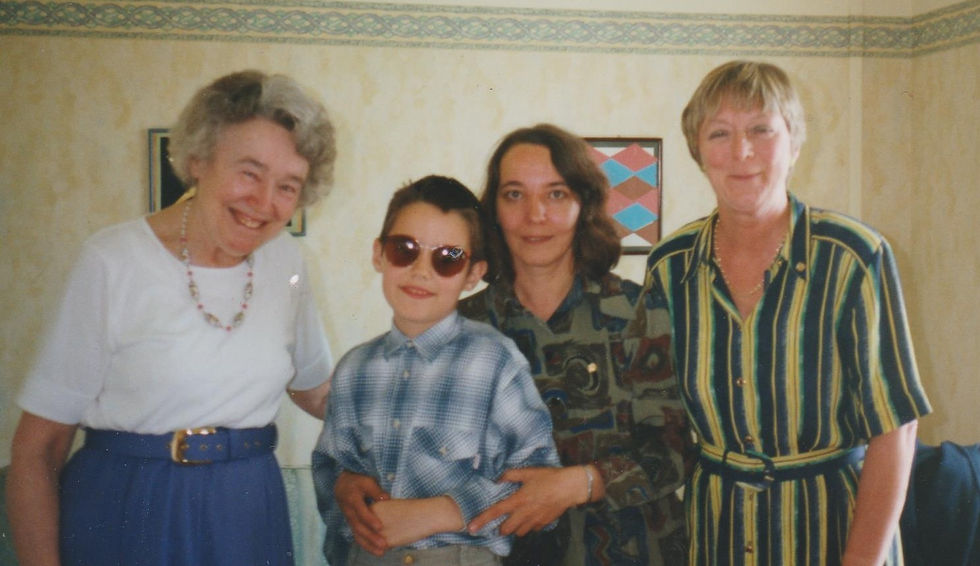
With Lorna Wing and Judith Gould, Storm House School, 1998.
A moment that, in hindsight, shaped both my personal and professional understanding of autism.
Years later, we met again in 2010 at the International Autism Conference in Odense, Denmark. I was presenting my own theoretical work – a sensory-perceptual framework aimed at explaining the underlying mechanisms behind the communication and language development in autism, Triad of Impairments and Theory of Autistic Mind (ToAM).
Knowing that Lorna Wing was in the audience, I felt a quiet apprehension. After my presentation, I approached her to explain that my intention was not to challenge her work, but to build on it. She responded with warmth and intellectual generosity, saying she found my approach logical and convincing.
I was deeply moved. Here was a figure I regarded as foundational – both a pioneering scientist and a mother whose experience resonated with my own – and she responded with openness, curiosity, and kindness.
The following day, we spoke for nearly two hours at the airport. We shared stories of our children. She spoke of Susie – of her warmth, her presence, and the devastating loss following her death in 2005. “She couldn’t express her emotions,” Wing said, “but when you came home, her face would light up.”
At one point, our conversation returned to the spectrum concept. She explained that it had been introduced to ensure that children who were previously excluded could finally receive support.
Then she paused and said quietly: “I’m afraid I’ve opened a Pandora’s box...”
The Paradox of Progress
Wing’s remark captures the paradox of her legacy.
The spectrum model was born out of necessity and compassion. It dismantled exclusionary definitions, expanded access to care, and humanised autism.
Yet its success also introduced new complexities.
The broadening of diagnostic criteria has contributed to a significant rise in prevalence estimates worldwide. While this reflects improved recognition, it has also blurred distinctions between individuals with profound disabilities and those with milder presentations. Scholars continue to debate whether these represent variations along a single spectrum or qualitatively different conditions.
Wing herself recognised this tension and cautioned against losing sight of those with the most significant needs.
*****
Dr. Lorna Wing’s vision was rooted in empathy – for children who had been excluded, misdiagnosed, and denied support. The spectrum was never intended to dilute autism, but to ensure that no one who needed help would be left outside its boundaries.
Yet the contemporary landscape reveals a difficult irony. As the spectrum has expanded, so too has the diversity of those included within it. Public discourse is increasingly shaped by individuals who can articulate their experiences, often reframing autism primarily as difference rather than disability and redefining it in accordance with their own individual “lived experiences” and understanding. While this shift has brought important recognition, it has also, unintentionally, redirected attention.
Those with the most profound forms of autism – individuals who are nonverbal, intellectually disabled, and fully dependent on others – risk becoming not only less visible, but less central to how autism itself is understood. Their needs are not simply different in degree, but in kind, requiring sustained, intensive support that cannot be captured within broader, more generalised narratives.
If the spectrum is to remain faithful to its original purpose, it must continue to hold space for its most vulnerable members. Otherwise, the very framework created to include risks redefining autism in ways that leave its most vulnerable no longer at its centre.
There is still hope – but only if we remember why the spectrum was created in the first place.
_________________________
[1] "Impairment of imagination" was replaced by the broader category of Restricted, Repetitive, and Stereotyped Patterns of Behavior, Interests, Activities, and rigidity of thinking.
[2] Terminology reflects diagnostic practices the clinical language in use at the time.


I began working with Autistic adults in the early 1990's and for ten years stuggled to work with the received view of the syndrome. I asked my managers and in-house psychology team 'What are 'Rituals'?' and went away, quite happily, with the answer 'They are dysfunctional behaviour!'. Then, in the British Library, following an unconnected trail of my own research, I came across Olga's 'a reconstruction of the sensory world of autism' (2001). It was my Eureka moment.
If I thought that I was bring Good News to my team of the time, I was to be sorely disappointed. As a psychological disorder, Autism is practically untreatable, it's the wrong toolbox.